Conducting a Review of Policies and Procedures

Programme Introduction

Policies and procedures are one of the most important sets of documents required to operate an early childhood service. However, having the most professional and comprehensive policy manual is of no use if the policies it contains are not being implemented. Likewise, procedures that outline and guide everyday practice do little to inform and support staff if they are unfamiliar with them.

This practical programme will give you all the tools you need to carry out a review of the mandatory policies and procedures required by Tusla as part of your Quality Plan. You will also get tips and strategies about engaging staff with policies and ensuring consistent application across the early childhood setting. 

Components include: 

1. Why Policies and Procedures?
2. Which Policies and Procedures are Mandatory? 
3. Policy review and implementation (use guide).
 
*A comprehensive handout on policy review is included in the Reference Document Section. 
 

Please note: this programme will take around 1.5 hours to complete. However, the policy review itself will be a longer piece of work if the tools provided are applied. 

Programme Content

  • Legislative requirements
  • Resources to support policy development and review
  • Guide to reviewing policies and procedures
Key Learning Outcomes

Participants will:

1. Appreciate the importance of Policies and Procedures and conducting ongoing reviews.

2. Understand mandatory policy, procedure and statement requirements.

3. Conduct a review process and use resources to support this. 

4. Evaluate and review current policy documents to meet regulatory standards.
1.5 Hours

Free

Presentation with video/audio

Easy to follow components

Downloadable reference documents

Test multiple choice questions

Certificate of Completion

Notes for the course

You may also like

course-preview
Authentic Assessment through Emergent Practice (ICQAW Accredited)
Welcome to the training programme ‘Seeing Every Child’ child-led documentation for early learning! The Learning Objective of the full programme (4 modules) is to introduce child-centred documentation as an instrument to recognise, support and enhance children’s wellbeing, learning and development. This is Module 1.  Module 1- Authentic Assessment through Emergent Practice This training module explores five key components of child-centred practice and documentation in early education. It begins by examining emergent practice and the importance of placing the child at the centre of learning and decision-making. The module then explores how agentic educators foster agency in children, followed by an introduction to assessment practices that support learning and development in early education. It also considers how documentation can be used to recognise and celebrate each child's unique strengths, interests and experiences. Finally, the module introduces the MOSAIC framework as a child-centred approach to documenting children's learning, participation and development. Components are as follows: Component 1: Emergent Practice: Placing the Child at the Centre  Component 2: Agency: Agentic Educators enable Agentic Children   Component 3: Assessment for Early Education  Component 4: Seeing the Unique Child through Documentation  Component 5: MOSAIC as a Child-centred Documentation System.   *PLEASE READ 'NOTES FOR THE COURSE' BEFORE BEGINNING.    

04 Hours

€60.00
course-preview
Telling the Story of Learning: The story-based approach (ICQAW Accredited).
Welcome to the training programme ‘Seeing Every Child’ child-led documentation for early learning! The Learning Objective of the full programme (4 modules) is to introduce child-centred documentation as an instrument to recognise, support and enhance children’s wellbeing, learning and development. This is Module 2. MODULE 2: Telling the Story of Learning: The story-based approach.  This training module explores six key areas that support a story-based approach to documentation in early learning settings. It begins by examining emotional wellbeing as the foundation for all learning, before considering what holistic learning looks like in practice. The module then introduces ways to make children’s learning visible through stories, including the use of inquiry wall stories and transition stories to capture and share meaningful learning experiences. Finally, it explores the MOSAIC framework as a practical approach for documenting children’s voices, experiences and development through storytelling. Components are as follows: Component 1: Emotional wellbeing: The cornerstone of all learning. Component 2: What does holistic learning look like? Component 3: Making learning visible through stories. Component 4: Inquiry wall stories. Component 5: Transition stories. Component 6: MOSAIC as a framework for documentation through stories. *PLEASE READ 'NOTES FOR THE COURSE' BEFORE BEGINNING.
Coming Soon
course-preview
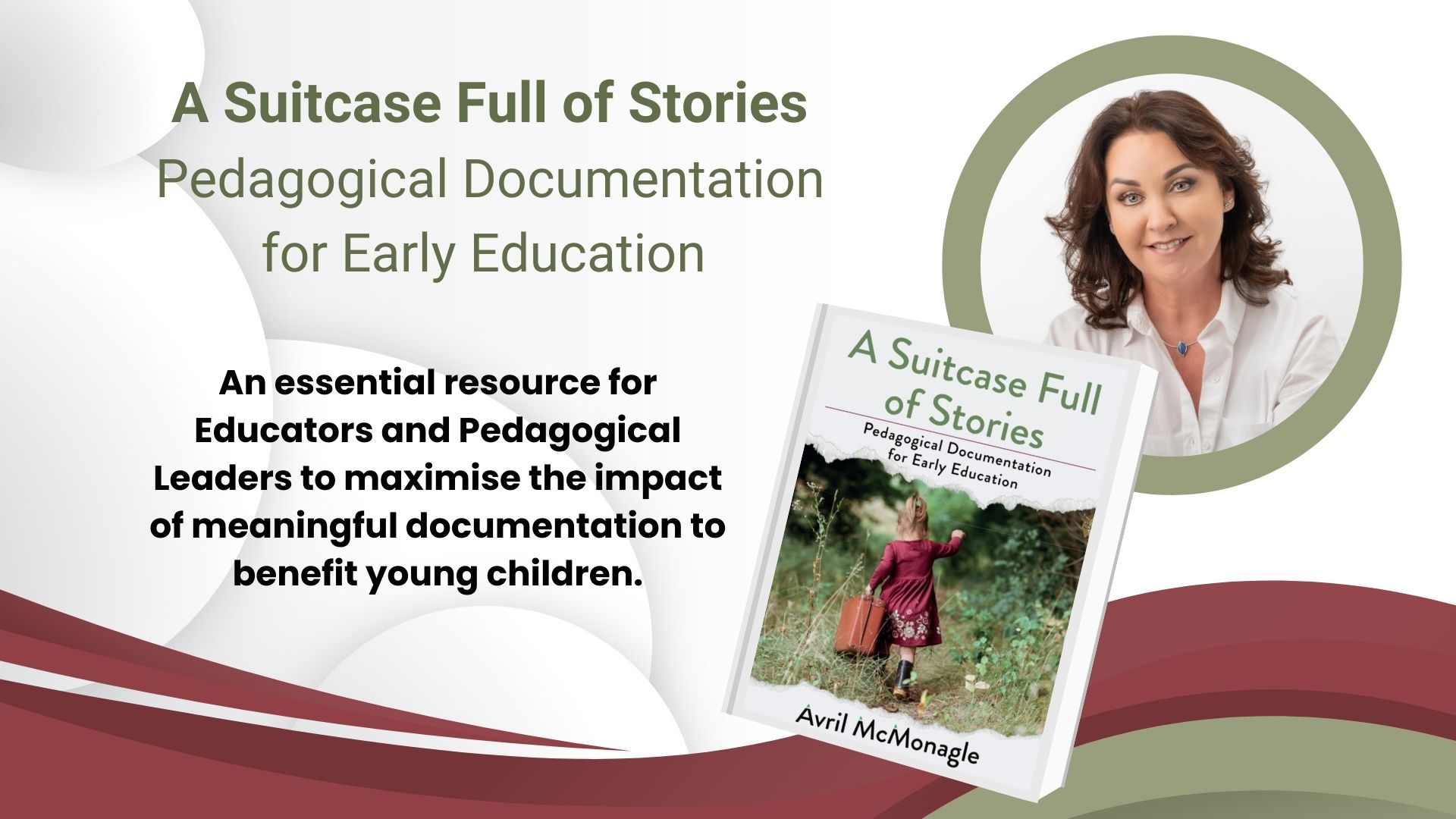
A Suitcase Full of Stories - Book information feature
This short presentation will give you a flavour of the creative new book A Suitcase Full of Stories by Avril McMonagle on pedagogical documentation for early education.   'A Suitcase Full of Stories' is an essential resource for Educators, Pedagogical Leaders and students to maximise the impact of meaningful child-led documentation for learning using a story approach. Packed with examples of learning stories, child voice and emergent planning, this book is about capturing children’s stories. It supports educators to develop the skills to tune-in to young children, to see and hear their voice and to use this information to build meaningful learning experiences through a child-led curriculum of play. Available from Amazon.uk/com Purchase here and from the MOSAIC Website A Suitcase Full of Stories - Paperback - MOSAIC (mosaicearlyed.com) This presentation is for information purposes only.  Downloadable flyer in 'Reference Document' section.   

0.5 Hours

Free